Description
Common Name: Banded Kuhli Loach
Latin name: Pangio kuhlii
Synonyms: Acanthophthalmus kuhlii
Tank Bred: Yes. Banded Kuhli Loaches are commercially bred in large numbers for the aquarium trade.
Distribution: Banded Kuhli Loaches are native to Southeast Asia, specifically to the islands of Java, Borneo, and Sumatra.
Max size: Banded Kuhli Loaches typically grow to around 3-4 inches (8-10 cm) in length.
Lifespan: With proper care, Banded Kuhli Loaches can live for up to 10 years in captivity.
Temperature range: 75-86°F (24-30°C)
pH Range: 5.5-7.5
KH Range: 1-10 dKH
Care level: Banded Kuhli Loaches require moderate care. They are hardy fish, but they do have specific requirements that must be met to keep them healthy.
Lighting Preference: Banded Kuhli Loaches prefer low lighting or subdued lighting. They will appreciate plenty of hiding places such as plants, driftwood, and rocks.
Suitable for planted tanks: Yes, Banded Kuhli Loaches can be kept in planted tanks as long as there are enough hiding places, and the plants are not too delicate.
Preferred food: Banded Kuhli Loaches are omnivorous and will eat a variety of foods. They should be fed a balanced diet of high-quality flakes, pellets, and frozen or live foods such as bloodworms and brine shrimp.
Behaviour: Banded Kuhli Loaches are peaceful fish that can be kept with other non-aggressive species. They are also nocturnal and will spend much of the day hiding in caves, under rocks, or in other hiding places.
Discoverer: Banded Kuhli Loaches were first described by the German naturalist Heinrich Kuhl in 1820.
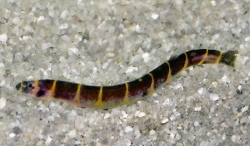
Interesting Facts: Banded Kuhli Loaches are known for their unique and distinctive appearance, with horizontal stripes running the length of their body. They are also bottom dwellers, and their long, slender bodies allow them to wriggle into tight spaces and burrow into the substrate. Banded Kuhli Loaches are delicate fish, and care should be taken to keep their water parameters stable and free of toxins.
able tank mates include other small tetras, rasboras, and peaceful dwarf cichlids.